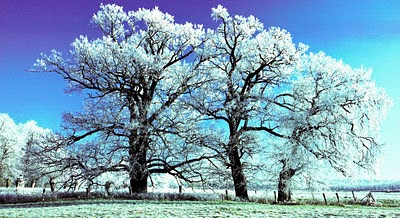
from "The Pasture"
On the velvet sward stretched, for a bed,
On the bosom of sunshiny May,
While a hillock supported his head.
I think when, in weeding, the maid
Made choice of a hill for her seat;
When the winds so deliciously played
In her curls, 'mid her blushes so sweet.
I think of gay groups in the shade,
In hay-time, with noise never still,
When the short sward their gay cushions made.
And their dinner was spread on a hill.
I think when, in harvest, folks lay
Underneath the green shade of a tree,
While the children were busy at play,
Running round the huge trunk in their glee.
Joy shouted wherever I went;
And e'en now such a freshness it yields,
I could fancy, with books and a tent,
What delight we could find in the fields.
A Walk on High Beach, Loughton
I loved the Forest walks and beechen woods,
Where pleasant Stockdale showed me far away
Wild Enfield Chase, and pleasant Edmonton;
While Giant London, known to all the world,
Was nothing but a guess among the trees,
Though only half a day from where we stood.
Such is ambition! only great at home,
And hardly known to quiet and repose.
I loved the Forest walk, and often stood
To hear boys halloo to their wilder sheep;
While quiet Turner sat upon a hill,
And gentle Howard cut his sticks and sang.
The Sticker trailed her faggot on the ground,
And all the Forest seemed to live with joy.
May
[Image: The Shepherd’s Calendar (May) – Carry Akroyd]
Come queen of months in company
Wi all thy merry minstrelsy
The restless cuckoo absent long
And twittering swallows chimney song
And hedge row crickets notes that run
From every bank that fronts the sun
And swathy bees about the grass
That stops wi every bloom they pass
And every minute every hour
Keep teazing weeds that wear a flower
And toil and childhoods humming joys
For there is music in the noise
John Clare – The Shepherd’s Calendar (May - excerpt)
Hugh Lupton – The Ballad of John Clare (Chapter 2)
Graves of Infants
Infants' gravemounds are steps of angels, where
Earth's brightest gems of innocence repose.
God is their parent, so they need no tear;
He takes them to his bosom from earth's woes,
A bud their lifetime and a flower their close.
Their spirits are the Iris of the skies,
Needing no prayers; a sunset's happy close.
Gone are the bright rays of their soft blue eyes;
Flowers weep in dew-drops o'er them, and the gale gently sighs.
Their lives were nothing but a sunny shower,
Melting on flowers as tears melt from the eye.
Each death
Was tolled on flowers as Summer gales went by.
They bowed and trembled, yet they heaved no sigh,
And the sun smiled to show the end was well.
Infants have nought to weep for ere they die;
All prayers are needless, beads they need not tell,
White flowers their mourners are, Nature their passing bell.
from Child Harold
I rest my wearied life in these sweet fields
Reflecting every smile in natures face
& much of joy this grass — These hedges yields
Not found in citys where crowds daily trace
Heart pleasures there hath no abideing place
The star gemmed early morn the silent even
Hath pleasures that our broken hopes deface
To love too well leaves nought to be forgiven
The Gates of Eden is the bounds of heaven
(lines 1222 to 1230)
The winter time is over love
White thorns begin to bud
& brown & green of freshness love
Enlivens all the wood
Theres white clouds got agen the sun
One daisey open on the green
The primrose shows its sulphur bud
Just where the hazel stulps are seen
& ere the april time is out
Along the ridings gravel walk
The bedlam primrose blooms about
Wi' twenty blossoms on a stalk
How happy seems the drop of dew
That nestles in the daiseys eye
How blest the cloud seems in the blue
That near the sun appears to lie
How happy does thy shadows seem
That stretches oer the morning grass
They seeims to walk as in a dream
I know their shadows as they pass
The primrose over withered leaves
Now beautifully shines
Ballad (from Child Harold)

Where I Strolled With Patty Adown In The Glen
& Spent Summer Evenings & Sundays Unseen
How Sweet The Hill Brow
& The Low Of The Cow
& The Sunshine That Gilded The Bushes So Green
When Evening Brought Dews Natures Thirst To Allay
& Clouds Seemed To Nestle Round Hamlets & Farms
While In The Green Bushes We Spent The Sweet Day
& Patty, Sweet Patty, Was Still In My Arms
The Love Bloom That Redded Upon Her Sweet Lips
The Love Light That Glistened Within Her Sweet Eye
The Singing Bees There That The Wild Honey Sips
From Wild Blossoms Seemed Not So Happy As I
How Sweet Her Smile Seemed
While The Summer Sun Gleamed
& The Laugh Of The Spring Shadowed Joys From On High
While The Birds Sung About Us & Cattle Grazed Round
& Beauty Was Blooming On Hamlets & Farms
How Sweet Steamed The Inscence Of Dew From The Ground
While Patty Sweet Patty Sat Locked In My Arms
April

The infant April joins the spring
And views its watery skye
As youngling linnet trys its wing
And fears at first to flye
With timid step she ventures on
And hardly dares to smile
The blossoms open one by one
And sunny hours beguile
But finer days approacheth yet
With scenes more sweet to charm
And suns arive that rise and set
Bright strangers to a storm
And as the birds with louder song
Each mornings glory cheers
With bolder step she speeds along
And looses all her fears
John Clare – The Shepherd’s Calendar (April - excerpt)
The village band crossed the street and made its way slowly among the hobbling pilgrims, along Church Lane towards Eastwell Spring.
Hugh Lupton – The Ballad of John Clare (Chapter 16)
Nor turnd my rambles to the pasture brook
Were in my youth at ‘Eastwells’ fountain side
Which winters never froze nor summer dryd
Young men & maidens usd to talk & play
n the cool shadows of its willows grey
Drinking loves healths in totts of sugard drink
On the soft swellings of its rushy brink
From the spring head like winter cold & chill
Were boils the white sand that is never still
Now swimming up in silver threads & then
Slow siling down to bubble up agen
There shepherds usd to sit & tell the while
Their tales & jokes to win each maidens smile
(From, “The Memory of Love”, lines 353-366)
Some Account of my Kin, my Tallents & Myself (II of II)
That its origional youll all agree
& tho my pen is often on the itch
Ive kept as yet from thieving pretty free
To tell the truth Ive hardly stole from any
Save some few things from worthey mother Bunch
A joke from Miller (praisd as mine by many)
For an old pedlar once who acted punch
If you like this Ill tell you tales by dozens
Which youll find pretty or I miss my aim
To strengthen this I might bring in my cousins
Who swear Im hastning up the hill to fame
But of friends praise I cant say Im a lover
For they like all are very prone to puff
Oft magazines laud books upon the cover
That prove when read most disagreeable stuff
So here Ill leave this sample to its fate
Send me the ‘London’ if you take the hint
Twill get you half a crown at any rate
For Ill give that to see my name in print
& be as't will Ill wait & hope the better
Gran poor old creature will be all delight—
& as Aunt Prissey often ends a letter
When getting late—I wish you all good night
June 14, 1821 past 10 o'clock
Blog Views - read and try this today (!)

Some Account of my Kin, my Tallents & Myself (I of II)

Nor wealth nor learning ever makes a poet
Tis natures blessing so the story goes
& my condition goes the way to show it
Tho up to Bible classes I was taught
My school account is hardly worth the telling
I staid no time to master as I ought
A hardish chapter in it without spelling
A timber merchant father was—that is
A maker & a seller out of matches
This honest truth somes very apt to quiz
That can do nothing but such meddling catches
These I woud ask is the prime strops of Packwood
A pin the worse cause he has humbler been
Then why—but hold—I quake at Mr B[lackwood]
Hell rap my knuckles in his magazine
Things may (as gran observes of Turners Blacking)
Be very good & very worthy praise
But theres such puffing & such swindling quacking
That merits next to nothing now adays
Some praise themselves some by their friends are stuck
As highs our weathercock upon the steeple
While all beside are trampld in the muck
I humbly hope youre no such kind of people
Truth waits times touchstone as the just attacker
To burst the bubble & to put to rout
Each pompous sounding literary cracker—
Mine lives as long as many Ive no doubt
I will but print them as I hinted at
Deceit may be decieved its no great matter
Big as a frog I almost burst with that
She puffs me up but she is apt to flatter
From "Childhood"

From "The Poets Wish"

In golden letters, richly bound
While one snug room not over small
Containd my ness[ess]ary all
& night & day left me secure
'Mong books my chiefest furniture
With littering papers many a bit
Scrawld by the muse in fancied fit—
& curse upon that routing jade
My territorys to invade
That found me out in evil hour
To brush & clean & scrub & scour
& with a dreaded brush & broom
Disturbd my learned lumber room
Such Busy things I hate to see
Such troublers neer should trouble me
Let dust keep gathering on the ground
& roaping cobwebs dangle round
Oh Come to my Arms

When the veil o' the evening falls dewy and grey
O' come to me under the awthorn green
When eventide falls i' the bushes serene
O come to me under the awthorn tree
When the lark's on his nest and gone bed is the bee
When the veil of the evening falls dark on the scene
And we'll kiss love and court i' the bushes so green
O come to me dear wi' thy own Maiden head
Where the wild flowers and rushes shall make thee a bed
We will lye down together in each others arms
Where the white Moth flirts by not give us alarms
Where the rush bushes bend and are silvered wi' dew
Ere the sunbeam the red cloud O' morning breaks through
Thy face is so sweet and thy neck is so fair
O' come at eve dearest and live with me there
Sighing for Retirement
O take me from the busy crowd,I cannot bear the noise!
For Nature's voice is never loud;
I seek for quiet joys.
The book I love is everywhere,
And not in idle words;
The book I love is known to all,
And better lore affords.
The book I love is everywhere,
And every place the same;
God bade me make my dwelling there,
And look for better fame.
I never feared the critic's pen,
To live by my renown;
I found the poems in the fields,
And only wrote them down.
(excerpt)
Idle Fame
I would not wish the burning blazeOf fame around a restless world,
The thunder and the storm of praise
In crowded tumults heard and hurled.
I would not be a flower to stand
The stare of every passer-bye;
But in some nook of fairyland,
Seen in the praise of beauty's eye.
--- oOo ---
My Dear Patty,
I have been so long silent that I feel ashamed of it, but I have been so much engaged that I really have not had time to write; and the occasion of my writing now is only to tell you that I shall be at home next week for certain. I am anxious to see you and the children and I sincerely hope you are all well. I have bought the dear little creatures four books, and Henry Behnes has promised to send Frederick a wagon and horses as a box of music is not to be had. The books I have bought them are "Puss-in-Boots," "Cinderella," "Little Rhymes," and "The Old Woman and Pig"; tell them that the pictures are all coloured, and they must make up their minds to chuse which they like best ere I come home. Mrs. Emmerson desires to be kindly remembered to you, and intends sending the children some toys. I hope next Wednesday night at furthest will see me in my old corner once again amongst you. I have made up my mind to buy Baxter "The History of Greece," which I hope will suit him.
I have been poorly, having caught cold, and have been to Dr. Darling. I would have sent you some money which I know you want, but as I am coming home so soon I thought it much safer to bring it home myself than send it; and as this is only to let you know that I am coming home, I shall not write further than hoping you are all well -- kiss the dear children for me all round -- give my remembrances to all -- and believe me, my dear Patty,
Yours most affectionately,
John Clare
During this stay in London, Clare had had proofs that his poems were not completely overlooked. Strangers, recognizing him from the portrait in the "Village Minstrel," often addressed him in the street. In this way he first met Alaric A. Watts, and Henry Behnes, the sculptor, who induced Clare to sit to him. The result was a strong, intensely faithful bust (preserved now in the Northampton Free Library). Hilton, who had painted Clare in water-colours and in oils, celebrated with Behnes and Clare the modelling of this bust…
(from ‘Poems Chiefly From Manuscript’
Edited by Edmund Blunden and Alan Porter.
New York: G. P. Putnam's Sons, 1921
March
And oft the shepherd in his path will spye
The little daisey in the wet grass lye
That to the peeping sun enlivens gay
Like Labour smiling on an holiday
And where the stunt bank fronts the southern sky
By lanes or brooks where sunbeams love to lye
A cowslip peep will open faintly coy
Soon seen and gatherd by a wandering boy
A tale of spring around the distant haze
Seems muttering pleasures wi the lengthning days
Morn wakens mottld oft wi may day stains
And shower drops hang the grassy sprouting plains
And on the naked thorns of brassy hue
Drip glistning like a summer dream of dew
While from the hill side freshning forest drops
As one might walk upon their thickening tops
And buds wi young hopes promise seemly swells
Where woodman that in wild seclusion dwells
John Clare – The Shepherd’s Calendar (March - excerpt)
Heath Field is caught tight now in a taut net of straight fences and new-planted hedgerows. She climbed over one fence after another. She pushed between the quick-thorn bushes and the thorns tugged at her cloak, A fox barked in Royce's Wood. She quickened her step. The wind sang among the branches of the willows along the dyke edge. She jumped the stream, holding up her skirts. She strode with a purpose. The moon came and went behind the scudding clouds and she seemed to walk through the darkness with a possessed assurance. She did not stumble. There was a shepherd's lambing wagon at the lower end of Heath Field. She gave it a wide berth. When she came to Torpel Way she followed it westward to Maxham's Green Lane, drawing her cloak about herself.
It was only as she passed the piles of fencing slats at the edge of Snow Common that her pace slowed and for the first time she caught her foot on the rough tussocks of the common.
Hugh Lupton – The Ballad of John Clare (Chapter 15 – Shrove Tuesday)
A Moments Rapture while bearing the Lovley Weight of A. S---R---S
Unequal'd raptures happiest happiness
For sure no raptures can compare with thee
Now lovley Anna in her sunday dress
In softest pressure sits upon my knee.—
For O to see the snowey bosom heave
And feel those robes to me so softley cleave
Robes which half show what modesty consceals
While round her slender wa[i]ste I fling my arms
And while her eye what's wanting yet reveals
To me apears such (more than heavenly) charms
That might I wish—and could I be so blest
To have it granted—O I'd wish to be
For ever of this matchles maid posses'd
To bear her weight through all Eternity
The Approach of Spring (IV)
I've met the Winter's biting breathIn Nature's wild retreat,
When Silence listens as in death,
And thought its wildness sweet;
And I have loved the Winter's calm
When frost has left the plain,
When suns that morning waken'd warm
Left eve to freeze again.
I've heard in Autumn's early reign
Her first, her gentlest song;
I've mark'd her change o'er wood and plain,
And wish'd her reign were long;
Till winds, like armies, gather'd round,
And stripp'd her colour'd woods,
And storms urged on, with thunder-sound,
Their desolating floods.
And Summer's endless stretch of green,
Spread over plain and tree,
Sweet solace to my eyes has been,
As it to all must be;
Long I have stood his burning heat,
And breathed the sultry day,
And walk'd and toil'd with weary feet,
Nor wish'd his pride away.
But oft I've watch'd the greening buds
Brush'd by the linnet's wing,
When, like a child, the gladden'd woods
First lisp the voice of Spring;
When flowers, like dreams, peep every day,
Reminding what they bring,
I've watch'd them, and am warn'd to pay
A preference to Spring.
The Approach of Spring (III)
This, my third posting of Clare's The Approach of Spring, is dedicated to the students of City College, Plymouth where yesterday I gave lectures (well chatted really) on The Life and Work of John Clare. A very attentive and interested group of students, most of whom had not previously been aware of the amazing poetic genius of Clare. A joy for me, and I hope for those present.Sweet messengers of morn,
And drops hang glistening after rain
Like gems on every thorn;
What though the grass is moist and rank
Where dews fall from the tree,
The creeping sun smiles on the bank
And warms a seat for thee.
The eager morning earlier wakes
To glad thy fond desires,
And oft its rosy bed forsakes
Ere night's pale moon retires;
Sweet shalt thou feel the morning sun
To warm thy dewy breast,
And chase the chill mist's purple dun
That lingers in the west.
Her dresses Nature gladly trims,
To hail thee as her queen,
And soon shall fold thy lovely limbs
In modest garb of green:
Each day shall like a lover come
Some gifts with thee to share,
And swarms of flowers shall quickly bloom
To dress thy golden hair.
All life and beauty warm and smile
Thy lovely face to see,
And many a hopeful hour beguile
In seeking joys with thee:
The sweetest hours that ever come
Are those which thou dost bring,
And sure the fairest flowers that bloom
Are partners of the Spring.
(tbc)
The Approach of Spring (II)
Left by the stormy blast,
The little hopeful blossom peeps,
And tells of winter past;
A few leaves flutter from the woods,
That hung the season through,
Leaving their place for swelling buds
To spread their leaves anew.
'Mong wither'd grass upon the plain,
That lent the blast a voice,
The tender green appears again,
And creeping things rejoice;
Each warm bank shines with early flowers,
Where oft a lonely bee
Drones, venturing on in sunny hours,
Its humming song to thee.
The birds are busy on the wing,
The fish play in the stream;
And many a hasty curdled ring
Crimps round the leaping bream;
The buds unfold to leaves apace,
Along the hedgerow bowers,
And many a child with rosy face
Is seeking after flowers.
The soft wind fans the violet blue,
Its opening sweets to share,
And infant breezes, waked anew,
Play in the maidens' hair—
Maidens that freshen with thy flowers,
To charm the gentle swain,
And dally, in their milking hours,
With lovers' vows again.
(tbc)
The Approach of Spring (I)
Thy sight the day beguiles;
For fresher greens the fairy ring,
The daisy brighter smiles:
The winds, that late with chiding voice
Would fain thy stay prolong,
Relent, while little birds rejoice,
And mingle into song.
Undaunted maiden, thou shalt find
Thy home in gleaming woods,
Thy mantle in the southern wind,
Thy wreath in swelling buds:
And may thy mantle wrap thee round,
And hopes still warm and thrive,
And dews with every morn be found
To keep thy wreath alive.
May coming suns, that tempt thy flowers,
Smile on as they begin;
And gentle be succeeding hours
As those that bring thee in:
Full lovely are thy dappled skies,
Pearl'd round with promised showers,
And sweet thy blossoms round thee rise
To meet the sunny hours.
The primrose bud, thy early pledge,
Sprouts 'neath each woodland tree,
And violets under every hedge
Prepare a seat for thee:
As maids just meeting woman's bloom
Feel love's delicious strife,
So Nature warms to find thee come,
And kindles into life.
(to be continued...)
from 'Address to a Lark'
I'm poor enough, there's plenty knows it ;Obscure ; how dull, my scribbling shows it :
Then sure 'twas madness to suppose it,
What I was at,
To gain preferment ! there I'll close it :
So mum for that.
Let mine, sweet Bird, then be a warning :
Advice in season don't be scorning,
But wait till Spring's first days are dawning
To glad and cheer thee ;
And then, sweet Minstrel of the morning,
I'd wish to hear thee.
February
The thatch moss glows in brighter green
And eaves in quick succession drops
Where grinning icicles hath been
Pit patting wi a pleasant noise
In tubs set by the cottage door
And ducks and geese wi happy joys
Douse in the yard pond brimming oer
The sun peeps thro the window pane
Which childern mark wi laughing eye
And in the wet street steal again
To tell each other spring is nigh
Thus nature of the spring will dream
While south winds thaw but soon again
Frost breaths upon the stiffening stream
And numbs it into ice—the plain
Soon wears its merry garb of white
And icicles that fret at noon
Will eke their icy tails at night
Beneath the chilly stars and moon
Nature soon sickens of her joys
And all is sad and dumb again
John Clare – The Shepherd’s Calendar (February - excerpt)
Snow has given way to rain again and everywhere is mud. In the fields the men at their ploughs, or hedging and ditching, curse the cold wet that lashes their faces and the cloying mud that clogs their boots and drags them to a standstill. The shepherds set their backs to the wind as the winter lambing begins. The enclosure teams, at their fence-setting and stone-breaking, listen for the chiming of the church clock and count the hours until dusk when spades and hammers can be dropped and forgotten. The women, hurrying from dairy to coop, from kitchen to midden, lift their gowns and scold the wet that soaks their feet and the puddles that stain and bedraggle the hems of their petticoats. They curse the splashing horses and carts that throw up their stinking mud from the street. Only the ducks and geese in the yard-ponds rejoice at the wetness of the world.
Under the trees in the skirts of Oxey Wood and Royce Wood and beneath the blackthorn bushes on the commons the nodding snowdrops are come, that with the first crying lambs signal that the winter season is beginning to slacken its hold.
Hugh Lupton – The Ballad of John Clare
(Chapter 14 – St. Valentine’s Day)
January
And braves the tempest as he may
The thresher first thro darkness deep
Awakes the mornings winter sleep
Scaring the owlet from her prey
Long before she dreams of day
That blinks above head on the snow
Watching the mice that squeaks below
And foddering boys sojourn again
By ryhme hung hedge and frozen plain
Shuffling thro the sinking snows
Blowing his fingers as he goes
To where the stock in bellowings hoarse
Call for their meals in dreary close
And print full many a hungry track
Round circling hedge that guards the stack
John Clare – The Shepherd’s Calendar (January - excerpt)
Twelfth Night is over and Plough Monday is past. Now it is Tuesday and work resumes and hard labour wastes no time in wiping the slate clean of the sweets of holiday and all the misrule of the day before, leaving only the aching limbs, the numbed fingers and the harsh coughs of winter.
Yesterday, Plough Monday, is the day that custom dictates that all men return to work and the season of ploughing begin. But custom is long-since beggared by usage, for the ploughs have been working the fields since October. And there are few men under thirty who, on Plough Monday, have their eyes on anything but the pint pot and the pie?
All is white with snow, and has been since Christmas night when the sky opened and the snow settled like feathers on the frozen ground, so that every battered, tattered, familiar place is become strange and beautiful, softened by the white fall that has folded its cold bright coverlet over match, stack, stable, street and field.
Hugh Lupton – The Ballad of John Clare (Chapter 13 - Plough Monday)
The Ballad of John Clare
As readers of this weblog will know, in the years since its genesis in 2005 I have very rarely used texts that were not written by Clare, but with the publication of The Ballad of John Clare in late 2010 I feel I must make an exception.Over the past couple of years there has been a number of novels about the life and work of Clare, all very much worth reading. But in this, Hugh Lupton's first novel, I feel we have something exceptional. Mark my words, this book will win prizes.
Hugh is planning to be present at our 30th Festival in Helpston (8th - 10th July 2011), speaking about and signing copies of this book. However in the months before then, and with Hugh's permission, I hope to post short extracts here... together with pertinent Clare poems.
Before this is commenced you will find below two reviews of the book, the first written by fellow John Clare Society Committee member Simon Kovesi. Published in the Independent Newspaper; the second by Kathy Stevenson in the Daily Mail. I must admit to agreeing with virtually every word:
"This novelisation of a year in the young life of the poet John Clare is a testament to a lifetime's groundbreaking commitment to folk culture. A renowned folk performer, but a first-time novelist, Hugh Lupton is neither a prose stylist, nor a formal innovator of fiction. But he is a master in two areas: storytelling and English rural folk culture. Lupton knows Clare and his village of Helpston, Northamptonshire, as well as anyone, and reconstructs Clare's times with a rare conviction. The context, landscape, language and texture of Clare's life and landscape are re-imagined in enchanting and accurate detail.
Clare has spoken to many creative people across the years: poets Arthur Symons and Edmund Blunden at the start of the twentieth century; Ted Hughes, Seamus Heaney, Derek Walcott and Paul Farley more recently. Playwrights have taken different routes through Clare's life: Edward Bond's play The Fool, revived brilliantly this year in Kilburn after a 35-year hiatus, sets the poet in a world of violent class war, while Simon Rae's play Grass, places an eco-warrior Clare in the 2001 foot-and-mouth pandemic.
Prose writers have also had varying takes on Clare: Alan Moore gives us a magical, anarchic version of Clare in Voice of the Fire; Iain Sinclair psycho-maps Clare's naturally contoured mind in Edge of the Orison; Richard Mabey takes Clare as his companion on a recovery from depression in the brilliant memoir Nature Cure. Serious thinkers like E. P. Thompson, Raymond Williams, Adam Phillips, Roy Porter and Ronald Blythe have also been thrilled by the access Clare provides to a long-forgotten, largely unwritten, world of labouring-class rural life and working intimacy with nature. Even Christopher Hitchens starts his polemic God is Not Great with an account of Clare.
But Clare's reach doesn't stop there. A wide variety of musicians continue to perform and record Clare's folksongs, fiddle music and ballads. The thriving John Clare Society will be thirty years old in 2011. Clare's poetry is now included in primary and secondary school curriculums. There are plans for TV documentaries and Hollywood interest too. His cottage in Helpston is now redeveloped into a glistening multi-million-pound Clare museum. This is truly Clare's moment - he's everywhere. But why is this previously obscure peasant poet of the natural world, born in poverty in 1793, who died in an asylum in 1864, suddenly of any relevance to us now?
The Ballad of John Clare provides the answer. Clare was born into a time of agricultural and social change. We live in a time of impending environmental catastrophe. The focus of this novel is enclosure - that massive reorganisation of the use of agricultural land that took place, parish by parish, inch by mapped inch, across the eighteenth and early nineteenth centuries. The rotating open field system of Clare's farming youth, peppered by common land, heaths, woods, scrub and wetlands, was reformed by Acts of Parliament. Rigid lines determined new ownership. Land was drained and reclaimed, hedged and fenced. Ditches were dug, rivers straightened, woodlands erased, and commons ploughed. Clare's horror at the abuses of the land around him - and the sheer ignorance of natural wonder that allowed it - led to a loss of a personal Eden from which he never recovered. There is therefore a direct relevance of Clare's poetic vision, and personal experience, to current anxieties about the ongoing impact of our industrialised, alienated distance from the earth and skies we continue to poison. Clare is now beginning to occupy the same place in relation to green environmentalism that Mary Wollstonecraft does in relation to feminism. Embedded within his proto-green politics is a celebration of common customs and common land, and an acute eye for an extraordinary rural life now all but gone."
Simon Kovesi --The Independent, 3rd December 2010
"Three novels about poet John Clare have now been published within a short space of each other - and why not? His story is, after all, the stuff of which fiction is made.
In this beautifully crafted book, Lupton has focused on one pivotal year of Clare's life; one that foretells the misery and mental problems that would beset him in later years.
But, this is not a book about just one man; it is about a society undergoing colossal upheavals from which the English countryside and its people have never recovered, when the Enclosures Act brings with it riches for some but abject poverty for many.
Lupton has brought to bear his vast understanding of English folklore and culture, and produced an exceptional evocation of an England lost."
Kathy Stevenson --The Daily Mail, November 26, 2010
Stanzas to Adelaide
Adelaide beautiful Adelaide seeThe spring is returning to beauty and thee
The snowdrops are breaking the soil and appear
As white as thy neck at the spring of the year
Adelaide beautiful Adelaide here
The primroses come and tis spring of the year
The primroses come and the birds mate in pairs
O when will my life be as happy as theirs
O when shall I woo thee and sit in the shade
Mong violets and primroses my sweet Adelaide
When in those bright eyes will those baby's appear
That I saw when I kissed thee last spring of the year
O Adelaide beautiful Adelaide hear
The snow drops have brought thee the spring of the year
The aconites open like rays of the sun
And tell thee the pleasures of spring is begun
Then Adelaide beautiful Adelaide hear
Let us take lovers walks at the spring of the year
from Child Harold
Tis winter & the fields are bare & wasteThe air one mass of ‘vapour clouds & storms’
The suns broad beams are buried & oercast
& chilly glooms the midday light deforms
Yet comfort now the social bosom warms
Friendship of nature which I hourly prove
Even in this winter scene of frost & storms
Bare fields the frozen lake & leafless grove
Are natures grand religion & true love
(lines 901 - 909)
SONG: The winter stays till e'en & the spring it canna cum
The winter stays till e'en & the spring it canna cum& every cannie bud is nipt up before the bloom
The winter winna gae & it stays a day oer lang
Sae the flowers they canna blossom & the birdies get nae Sang
The young & cannie maiden canna gang by her ain gate
But brazen ruffian winter mun teaze her suin & late
Her gown to shun the dirt oft leaves her ancle bare
For her gown it is the best & her ony sabbath ware
Then brazen ruffian winter begins his bawdry sang
& calls her foul & filthy names & does her mickle wrang
But I loo to see her ancle & I loo to see her gown
Held up by her lily hand when rains are dripping doon
& if I see her bonny cauf it sets me in a bleeze
The pillars o' king Salomon are nat sae sweet as these
But winter blites wi' chilblains where love would leave a kiss
& woman lovely woman is ever used amiss
The winter stays till e'en & the spring it canna get
There's near a way for maids to gaing & neer a blossom yet
There's ne'er a wa' for womans gate luik which a wa we will
Yet still I loo a' woman kind & winna do her ill
I winna wrang a woman for the best bluid in my veins
I winna wrang a woman till the last of life remains
Though the spring it canna cum & the winter winna gang
I maun luv' aye worship woman in every tale & sang
To Hope
O Muse bestow—nor think it vain(While praise rebounds in just excess)
To a weak clown one single strain,
Fit and becoming hopes address,
For O in every grief we find
Her ready aid to cheer the mind.
Hail soothing hope recruiting power
In penitence and haples fate;
Assistant proof in latest hour
E'en thro the prisons gloomy grate
Where Culprits almost hopless grieve
Thy form will glimmer to reprieve.
Thro life thus far—(so cloth'd in stains
Of Motley troubles as it is)
Me thou hast chear'd and still remains
To point to shores of endless bliss,
Tho doom'd perhaps another way
Sweet hope endears the wisht essay.
Thou balmy bland enlivner hail
Or false or true to the distrest
Thy form will dart in sorrows vale
A thwarting joy on troubles breast.
Mary Green
Was there ever such a hueO Loves bonny Mary Green
On the rosey pearled in dew
As on thy cheek is seen
On choice carnation leaves
Was there e'er so rich a streak
When thy white bosom heaves
As thy lips that music speak
Shall I twine the weeping willow
Round the bloom of Mary Green
Oer her bosoms snowy pillows
& her face so like a queen
Shall the cypress glooms be wreathing
Like a lump o' coffined clay
Round that form o' beauty breathing
All the witcherys o' May
O my lovely Mary Green
The richest flower o' May
On thy bonny face is seen
Which love winna take away
Thy dress sae neat thy face sae sweet
As bonny as a queen
Thou'rt loves own sweetheart a' compleat
My bonny Mary Green
January
[Image: Carry Akroyd - The Shepherd's Calendar]Withering and keen the winter comes
While confort flyes to close shut rooms
And sees the snow in feathers pass
Winnowing by the window glass
And unfelt tempests howl and beat
Above his head in corner seat
And musing oer the changing scene
Farmers behind the tavern screne
On hob reclines the corners guest
Reading the news to mark again
The bankrupt lists or price of grain
Or Old Moores annual prophecys
That many a theme for talk supplys
Whose almanacks thumbd pages swarm
Wi frost and snow and many a storm
And wisdom gossipd from the stars
Of politics and bloody wars
He shakes his head and still proceeds
Ne'er doubting once of what he reads
from 'December'
And some, to view the winter weathers,Climb up the window-seat with glee,
Likening the snow to falling feathers,
In fancy's infant ecstasy;
Laughing, with superstitious love,
O'er visions wild that youth supplies,
Of people pulling geese above,
And keeping Christmas in the skies.
As tho' the homestead trees were drest,
In lieu of snow, with dancing leaves,
As tho' the sun-dried martin's nest,
Instead of ickles, hung the eaves,
The children hail the happy day—
As if the snow were April's grass,
And pleas'd, as 'neath the warmth of May,
Sport o'er the water froze to glass.
Thou day of happy sound and mirth,
That long with childish memory stays,
How blest around the cottage hearth
I met thee in my younger days!
Harping, with rapture's dreaming joys,
On presents which thy coming found,
The welcome sight of little toys,
The Christmas gift of cousins round:
The wooden horse with arching head,
Drawn upon wheels around the room,
The gilded coach of gingerbread,
And many-colour'd sugar-plum,
Gilt-cover'd books for pictures sought,
Or stories childhood loves to tell,
With many an urgent promise bought,
To get to-morrow's lesson well;
And many a thing, a minute's sport,
Left broken on the sanded floor,
When we would leave our play, and court
Our parents' promises for more.
(lines 73-108)
The Hour of Prayer
Ave Maria! woman mild,—Mother ever young and fair,
Hushing slumbers to her child,—
It is the hour of Prayer!
When children bend the artless knee,
And mothers kneel beside 'em there,
Maiden mild my guardian be,
In eve's still hour of Prayer!
A light in darkness, be thou still,
Let love's affections be thy care;
Thou beacon light of good and ill,
Attend the hour of Prayer!
The darkness comes, the dews descend;—
Thou woman ever mild and fair!
Be to the friendless still a friend,
In the silent hour of Prayer!
'Tis come!—the o'erpowering heat of day
Seeks night, its peace to share;
Sweet maiden teach us how to pray
In silent hours of Prayer!
LP I 383
After a Fine Winters Day
Old winters grinning horrors forcful smild
His flinty bosom thawd wi tenderness
So fiercfull savages have melted mild
Neath the sweet looks of womans lovliness
So poesy thy witcheries so wild
Doth warm the chilly heart of wants distress
& forcful give a joy to natures child
Spite of his anguish—ah he coud express
Full many a pleasure & full many a pain
Mingling like gaul & honey sun & rain
A fine decembers day thou art to me
Tho winter still beneath thy rays remain
Her grinning frowns are melted soft by thee
The Robin
Now the snow hides the ground little birds leave the woodAnd flie to the cottage to beg for their food
While the domestic robin more tame then the rest
(With its wings drooping down and rough feathers undrest)
Comes close to our windows as much as to say
‘I would venture in if I could find a way
I'm starv'd and I want to get out of the cold
O! make me a passage and think me not bold’
Ah poor little creature thy visits reveal
Complaints such as these to the heart that can feel
Nor shall such complainings be urged in vain
I'll make thee a hole if I take out a pane
Come in and a welcome reception thou'lt find
I keep no grimalkins to murder inclin'd
—But O! little robin be careful to shun
That house where the peasant makes use of a gun
For if thou but taste of the seed he has strew'd
Thy life as a ransom must pay for thy food
His aim is unerring his heart is as hard
And thy race tho so harmles he'll never regard
Distinction with him boy is nothing at all
Both the wren and the robin with sparrows must fall
For his soul (tho he outwardly looks like a man)
Is in nature like wolves of the appenine clan
Like them his whole study is bent on his prey
Like them he devours what e'er comes in his way
Then be careful and shun what is meant to betray
And flie from these men-masked wolves far away
Come come to my cottage and thou shalt be free
To perch on my finger or sit on my knee
Thou shalt eat of the crumbles of bread to thy fill
And have leisure to clean both thy feathers and bill
Then come little robin and never believe
Such warm Invitations are meant to deceive
In duty I'm bound to show mercy on thee
While God dont deny it to sinners like me!
Her Love is all to me
And winters snow has found his way For fifty miles around
I turn a look to every way And nothing to be seen
The frozen clouds shuts out the day And snow hide[s] all the green
The hedges all of leaves are bare my heart beats cold & chill
O' once I loved a pretty girl and love her dearly still
Though love is but a frozen pearl as you may plainly see
My lovely girl is handsome as any maid can be
Freeze on the bitter biteing sky Snows shade the naked tree
All desolate alone am I Yet I'll love none but thee
No tears I shed my love to show To freeze before they fall
No sighs I send along the snow But she's my all in all
The footpath leaves the ruts and carts O'er furrow and o'er rig
And my love lives at the ‘White Hart’ a stone throw from the brig
She's like a ballad sung in tune And deep in love to be
Her face is like the rose in June And her love is all to me
Distant Hills (excerpt)
[Image: Eddie Bairstow]If so my fancy idly clings
To notions far away,
And longs to roam for common things
All round her every day,
Right idle would the journey be
To leave one's home so far,
And see the moon I now can see
And every little star.
And have they there a night and day,
And common counted hours?
And do they see so far away
This very moon of ours?
I mark him climb above the trees
With one small cousin star,
And think me in my reveries—
He cannot shine so far.
And o'er his face that ancient man
Will ever stooping be;
What else he in no sort of plan
Could ever get to see.
The poets in the tales they tell
And with their happy powers
Have made lands where their fancies dwell
Seem better lands than ours.
(lines 29-52)
December
Each house is swept the day before
And windows stuck wi evergreens
The snow is beesomd from the door
And comfort crowns the cottage scenes
Gilt holly wi its thorny pricks
And yew and box wi berrys small
These deck the unusd candlesticks
And pictures hanging by the wall
Neighbours resume their anual cheer
Wishing wi smiles and spirits high
Glad christmass and a happy new year
To every morning passer bye
Milk maids their christmass journeys go
Accompanyd wi favourd swain
And childern pace the crumping snow
To taste their grannys cake again
Hung wi the ivys veining bough
The ash trees round the cottage farm
Are often stript of branches now
The cotters christmass hearth to warm
He swings and twists his hazel band
And lops them off wi sharpend hook
And oft brings ivy in his hand
To decorate his chimney nook
Old winter whipes his icles bye
And warms his fingers till he smiles
Where cottage hearths are blazing high
And labour resteth from his toils
December (lines 9-36)
Clare's self-doubt
I very infrequently post anything to this weblog but Clare's work, but here is a short extract from a recent paper that will be of interest to all Clare followers.Clare was never confident that he had fully attained the status of author that he had learned and been encouraged to value, in part because he could never fully shake off the status of peasant or rustic that had been thrust upon him as an authenticating signature, and in part because he suspected that his first success may have been founded upon the fleeting judgment of fashion rather than solid principles of taste.
Throughout his letters, Clare worries that his reputation as an author may rest upon false premises. As early as February 24, 1821, Clare worried Taylor with the idea that his patrons, Lord Radstock and Mrs. Emmerson, may have dropped him for a fresher child of nature: "so god send they may find out a new 'child of nature' to foster & flatter whose name is rather fresher then mine ..." (Letters 160).
Summing up his career as a poet to Henry, Francis Cary sometime after October 20,1832, Clare writes: "I felt some vanity that I had a claim to the title of a poet & it was the praise & commendation of men of genius that fostered that ambition" (Letters 594); anticipating the response to a new collection of poems, Clare goes on to say, "I wished to be judged of by the book itself without any appeals to want of education lowness of origin or any other foil that officousness [sic] chuses to encumber my path with" (Letters 594).
Thus, though there were moments when Clare asserted his poetic powers as strongly as any poet, his letters betray a long-standing ambivalence about the measure of his success. When, after 1827, Clare's correspondence with his "friends" in the literary establishment of London began to drop off, that ambivalence gave way to disappointment and even regret that he had ever knocked upon the door of literary success, for more often than not, he relied upon the approval of those literary men and women of genius to bolster his self-confidence.
from "Hybridity, Mimicry and John Clare's Child Harold"
by Gary Harrison
Love Scorned by Pride
Oh, far is fled the winter wind,And far is fled the frost and snow,
But the cold scorn on my love's brow
Hath never yet prepared to go.
More lasting than ten winters' wind,
More cutting than ten weeks of frost,
Is the chill frowning of thy mind,
Where my poor heart was pledged and lost.
I see thee taunting down the street,
And by the frowning that I see
I might have known it long ere now,
Thy love was never meant for me.
Oh, had I known ere I began
That love had been so hard to win,
I would have filled my heart with pride,
Nor left one hope to let love in.
I would have wrapped it in my breast,
And pinned it with a silver pin,
Safe as a bird within its nest,
And 'scaped the trouble I am in.
I wish I was a happy bird,
And thou a true and timid dove:
Oh, I would fly the land of grief,
And rest me in the land of love.
Oh, I would rest where I love best;
Where I love best I may not be:
A hawk doth on that rose-tree sit,
And drives young love to fear and flee.
Oh, would I were the goldfinch gay!
My richer suit had tempted strong.
Oh, would I were the nightingale!
Thou then hadst listened to my song.
Though deep thy scorn, I cannot hate;
Thy beauty's sweet, though sour thy pride;
To praise thee is to love thee still,
And it doth cheer my heart beside.
For I could swim the deepest lake,
And I could climb the highest tree,
The greatest danger face and brave,
And all for one kind kiss of thee.
Oh, love is here, and love is there:
Oh, love is like no other thing:
Its frowns can make a king a slave,
Its smiles can make a slave a king.
The Dream
Fierce raged destruction, sweeping o'er the land,And the last counted moment seemed at hand:
As scales near equal hang the earnest eyes
In doubtful balance which shall fall or rise,
So, in the moment of that crashing blast,
Eyes, hearts, and hopes paused trembling for the last.
Loud burst the thunder's clap, and yawning rents
Gashed the frail garments of the elements;
Then sudden whirlwinds, winged with purple flame
And lightnings' flash, in stronger terrors came;
Burning all life and nature where they fell,
And leaving earth as desolate as hell.
(lines 49-60)
Left in the world alone
[Image: 'Crow' from a Carry Akroyd poster]Left in the world alone
Where nothing seems my own
And everything is weariness to me
'Tis a life without an end
'Tis a world without a friend
And everything is sorrowful I see
There's the crow upon the stack
And other birds all black
While November's frowning wearily
And the black-clouds dropping rain
'Till the floods hide half the plain
And everything is weariness to me
The sun shines wan and pale
Chill blows the northern gale
And odd leaves shake and shiver on the tree
While I am left alone
Chilled as a mossy stone
And all the world is frowning over me
Song
I dreamed of love and thought it sweetAnd took the winter for the spring;
A maiden's charms won me to woo
Where beauty's blooms so thick did hing
That I from thence did fear no blast
To bid young hope's frail bud decay,
Till tenderest words met bitter scorn
And then I wished myself away—
But all too late; and such as she
Might well deceive the wisest mind,
For love sure ne'er met one before
So scornful bent, so seeming kind;
For fair as spring, as summer warm,
Her young blood it did seem to flow;
And yet her heart did prove so cold
Love's bud died there and could not blow.
Her face looks open as the day,
And in her lips and in her eyes
Smiles and goodwill do seem to play,
That are love's deaths in green disguise;
Her breasts peep from her kerchief folds
Like sunshine thro' a parting cloud,
And yet love finds within that bed
Naught but a dead and wintry shroud.
All hopes are gone that wished her mine;
And now her mind I prove and know
I'm glad—and yet methinks those hopes
That then did cheat did cheer me so
I almost wish I ne'er had sued,
But still hoped on and still believed;
For it were best to dream of joy
Than thus to wake and be deceived.
The autumn morn...
[ Image: ‘Autumn Field’ – NaomiBlum (naomiblum.com) ]The autumn morn looks mellow as the fruit
& ripe as harvest — every field & farm
Is full of health & toil — yet never mute
With rustic mirth & peace the day is warm
The village maid with gleans upon her arm
Brown as the hazel nut from field to field
Goes cheerily — the valleys native charm —
I seek for charms that autumn best can yield
In mellowing wood & time bleaching field
(Child Harold – lines 657-665)
Written in November
Autumn I love thy latter end to viewIn cold novembers day so bleak & bare
When like lifes dwindld thread worn nearly thro
Wi lingering pottering pace & head bleachd bare
Thou like an old man bids the world adieu
I love thee well & often when a child
Have roamd the bare brown heath a flower to find
& in the moss clad vale & wood bank wild
Have cropt the little bell flowers paley blue
That trembling peept the sheltering bush behind
When winnowing north winds cold & blealy blew
How have I joyd wi dithering hands to find
Each fading flower & still how sweet the blast
Woud bleak novembers hour Restore the joy thats past
Autumn
The fields are wet and dreary;
The rude storm takes the flowers of May,
And nature seemeth weary.
The partridge coveys shunning fate,
Hide in the bleaching stubble;
And many a bird without its mate,
Mourns o'er its lonely trouble.
On awthorns shine the crimson awe,
Where spring brought may-day blossoms;
Decay is natures cheerless law,
Life's winter in our bosoms.
The fields are brown and naked all,
But hedges still are green:
But storms shall come at autumns fall,
And not a leaf be seen!
Yet happy love that warms the heart,
Through darkest storms severe;
Keeps many a tender flower to start,—
When spring shall reappear,
Affections hope shall roseys meet;
Like those of summer bloom:—
And joys, and flowers, smell as sweet,
In seasons yet to come.


