Poet John Clare's home renovated to celebrate rural Britain

The educational centre in Cambridgeshire is dedicated to his odes to ants, April daisies and other natural world minutiae.

Jonathan Bate, a Romantic poetry professor and the author of a biography on the poet, said Clare had hugely influenced modern poets writing on the environment. "Many of the young poets interested in the environment today, such as John Burnside, Paul Farley, and Alice Oswald, are deeply influenced by Clare," he said. "It's partly his style of writing about nature with great precision, but also his concern with the local. His imagination is always grounded in a sense of place, which is a huge issue for modern poets - being universal by being local."

The former poet laureate Andrew Motion wrote of him: "Clare may not have the epic sweep of Wordsworth, or the compact excellence of Keats at his best, or the intellectual depth of Coleridge, but his best writing combines sharp seeing and deep feeling to a pitch of greatness." The son of a farm labourer, Clare also wrote poetry on unrequited love, the sometimes fragile nature of his mental health – he was twice admitted to asylums – and described the natural world in his local vernacular rather than the standard English deployed by his Romantic peers. The process of water beginning to freeze is known as "crizzling", stumps of trees are "stulps", and meddling is "proggling".

Robyn Llewellyn, head of Heritage Lottery Fund East of England, said: "John Clare wrote some of his most memorable work in Helpston, labouring for much of his life in the fields of the English countryside, and this is a wonderful opportunity to celebrate one of our nation's most important poets. Our funding has transformed the Clare cottage site and has enabled the important education programme inspiring visitors to share in his creativity and love of the environment and the English countryside."
.
The Guardian - 9th July 2009 (Excerpt & Photo)
Click on the title for the full article.

Festival 2009

Just back from a wonderful weekend:

It all starts with a roomful of friends… the hubbub, smiles and laughter that says “We’re SO glad that you could make it this year”. Helpston looking its July best – is there any other month in the village? Hollyhocks and roses everywhere. A new Journal to devour and a host of Clare friends to share our passion.

An outing to Glinton and the church and green. Poems and stimulating talk, of which more later.

For now, a 'Glinton' poem:

Glinton, thy taper spire predominates
over the landscape and the mind
musing the pleasing picture contemplates
like elegance of beauty much refined
by taste that almost defies and elevates
once admiration making common things
around it glow with beauty not their own.
Thus all around the earth superior things
those struggling trees though lonely seem not lone
but in thy presence wear superior power
and e'en each mossed and melancholy stone,
gleaning cold memories round oblivion's bower
seems types of fair eternity - and hire
a lease from fame by thy enchanting spire.

Clare on Radio 4

[Clare's Cottage in Helpston]

This morning at 7:20ish Paul Chirico was interviewed about the Epping to Helpston walk starting today, cluminating in the opening of Clare's Cottage. Here is the programme running order extract:
.
The Cambridgeshire cottage where 19th century poet John Clare lived is to open to the public. Members of the John Clare Trust are retracing an 80 mile walk to the cottage, that the poet once made, to celebrate the opening. Dr Paul Chirico, senior tutor at Fitzwilliman College Cambridge, discusses why the cottage is being turned into a centre dedicated to environmental education.
.
Here is John Clare on the same walk in 1841
.
I've wandered many a weary mile
Love in my heart was burning
To seek a home in Mary[s] smile
But cold is loves returning
The cold ground was a feather bed
Truth never acts contrary
I had no home above my head
My home was love & Mary

I had no home in early youth
When my first love was thwarted
But if her heart still beats with truth
We'll never more be parted
& changing as her love may be
My own shall never vary
Nor night nor day I'm never free
But sigh for abscent Mary

Nor night nor day nor sun nor shade
Week month nor rolling year
Repairs the breach wronged love hath made
There madness—misery here
Lifes lease was lengthened by her smiles
—Are truth & love contrary
No ray of hope my life beguiles
I've lost love home & Mary

Helpstone (lines 1-10, 30-40)

In the week of the 2009 John Clare Festival at Helpston (see below), a short extract from Clare's poem 'Helpstone' - above a photo of the Clare monument in the centre of the village.

Hail, humble Helpstone! where thy valleys spread,
And thy mean village lifts its lowly head;
Unknown to grandeur, and unknown to fame;
No minstrel boasting to advance thy name:
Unletter’d spot! unheard in poets’ song;
Where bustling Labour drives the hours along;
Where dawning Genius never met the day;
Where useless Ignorance slumbers life away;
Unknown nor heeded, where, low Genius tries
Above the vulgar, and the vain, to rise.

Hail, scenes obscure! so near and dear to me,
The church, the brook, the cottage, and the tree:
Still shall obscurity rehearse the song,
And hum your beauties as I stroll along.
Dear, native spot! which length of time endears;
The sweet retreat of twenty lingering years,
And, oh! those years of infancy the scene;
Those dear delights, where once they all have been;
Those golden days, long vanish’d from the plain;
Those sports, those pastimes, now belov’d in vain.

Festival 2009

7:00pm - 11th July 2009 - John Clare Festival (Helpston)
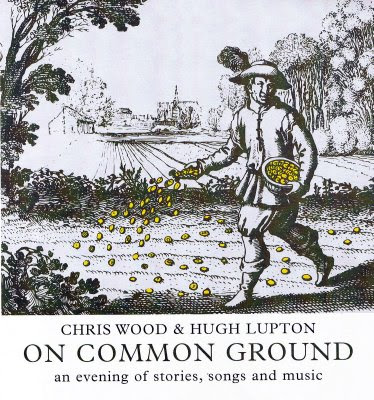
The landscape holds the memory of everyone who has ever trodden it… all we have to do is listen. In this programme of story, music, poetry and song Chris Wood and Hugh Lupton put their ears to the ground and tell the story of John Clare. It is a performance that explores the porous boundaries between language and place, madness and exile, love and loss.

Hugh is a master wordsmith, Chris is the leading folk musician of his generation, together they weave a beguiling magic.

“Sheer wizardry in the guise of utter simplicity…a packed house sat in a thrall of enchantment, no movement, no intrusive sounds… Hugh Lupton is joined by singer/fiddler Chris Wood, whose style is timeless and beguiling, his songs wonderfully evocative.”
Eastern Daily Press

“It's rare to hear work as powerful as Chris Wood and Hugh Lupton's. With beautifully sculpted prose and carefully honed music they seduce the minds of those who listen, skilfully drawing on the past to make sense of the present... This is welcome nourishment for those who like to think for themselves"
Verity Sharpe (Late Junction & The Culture Show)

“…. The images that billowed and faded in that darkened auditorium were quite different from those that unspool across a screen. I could put my hands in front of my face and the pictures would not vanish. They were inside me. They belonged to me. They were part of the history of the whole of human life.”
The Times

This is a programme that sings of the unsung and remembers the forgotten histories of the soil. Hugh & Chris are the winners of BBC Folk Award for Best Original Song 2006 for ‘One in a Million’.

John Clare Festival 2009

Not too long to this year's John Clare festival at his birthplace in Helpston. 10th - 12th July the weekend is packed with events.

2009 marks the 200th anniversary of the Helpston Enclosure Act, therefore 'Enclosure' will feature in much of the programme.

FRIDAY 10th
1.30pm at Helpston Parish Church
The Midsummer Cushion Ceremony. The pupils of the John Clare Primary School, Helpston bring the cushions of flowers to place around the grave of John Clare. The pupils’ prize winning poems are read, followed by a song and prayers.
.
6pm – a guided walk around Helpston.
.
6.30 pm – a guided walk around Maxey Pitts
An opportunity to experience this wonderful, brand new wetland reserve being created between Maxey and Etton. Meet outside the old Post Office at 6.15 pm. Transport provided.
.
8pm Folk music in the Barn at the Exeter Arms.

SATURDAY 11th
From 9.30am – coffee in the Botolph’s Barn – behind the church!

10:00am Festival opens in the school hall
Stalls include the John Clare Society sales, booksellers, local tourist offices and exhibitions.
.
Book for the Coach Tour and the evening performance of ‘Common Ground’ with the poet and story teller Hugh Lupton and the talented musician Chris Woods

10.30am (Marquee)
Welcome and Introduction to the Festival from the Chair of the Society. The Annual Meeting of the Society.

11.15am (Marquee)
President’s address by Ronald Blythe.

12noon – 1:00pm and 1.30pm – 2.30pm
Poetry Workshops in the school for children aged 6 -12 years led by Keely Mills – teacher and Poet Laureate of Peterborough.

Lunches in the Village Hall: John Clare Cottage open, Botolph’s Barn open: Morris Dancers and the Peterborough Folk Dance Society perform.

2:00pm (Marquee)
'Who Hung the Moles?', the story of enclosure – an illustrated talk with poetry readings by Richard Keymer and Richard Astle, from the Langdyke Countryside Trust.
.
3:00pm Coach outing
To Glinton where Clare went to school and Mary Joyce is buried. There will be a short village walk, poetry and song and teas in the church.

3:00pm Guided walks round Helpston - meet at the Butter Cross

3.15pm – 4pm In the church
Read your favourite poem.

Teas in the Village Hall

5.30pm
In the church another chance to your favourite Clare poem

7:00pm (Marquee)
‘Common Ground’ [Not to be missed]!
With story teller and poet Hugh Lupton
And the renowned musician Chris Woods

Tickets (£10 and £8 concess.) are available in the school hall or from Stamford and Peterborough Tourist Offices.

Later the Northamptonshire folk group Ock 'n Dough play in the Blue Bell.

SUNDAY 12th
11:00am Family service in St. Botolph’s Church
Celebrating Clare led by Vic-Chair of the Society Revd. Ron Ingamells.
.
HOPE TO SEE YOU THERE...

Footpaths (final) - from Footpaths

Theres somthing rich & joyful to the mind
To view through close & field those crooked shreds
Of footpaths that most picturesqly wind
From town to town or some tree hidden sheds
Where lonely cottager lifes peace enjoys
Far far from strife & all its troubled noise
The pent up artizan by pleasure led
Along their winding ways right glad employs
His sabbath leisure in the freshening air
The grass the trees the sunny sloping sky
From his weeks prison gives delicious fare
But still he passes almost vacant bye
The many charms that poesy finds to please
Along the little footpaths such as these

Now tracking fields where passenger appears
As wading to his waist in crowding grain
Where ever as we pass the bending ears
Pat at our sides & gain their place again
Then crooked stile with little steps that aids
The climbing meets us—& the pleasant grass
& hedgrows old with arbours ready made
For weariness to rest in pleasant shades
Surround us & with extacy we pass
Wild flowers & insect tribes that ever mate
With joy & dance from every step we take
In numberless confusion—all employ
Their little aims for peace & pleasures sake
& every summers footpath leads to joy

Footpaths - from 'Out of Door Pleasures'

The day is all round me the woods and the fields
And sweet is the singing their birds music yields
The waterfall music, there's none such at home
It spreads like a sheet, and then falls into foam
The meadows are mown, what a beautiful hue
There is in green closes as I wander through
A green of all colours, yellow, brown and dark grey
While the footpaths all darkly goes winding away
Creeping onto a foot-brig that crosses a brook
Or a gate, or a stile, and how rustic they look
Some leaning so much that the maidens will go
Lower down with their buckets, and try to creep through
There is nothing more sweet in the fields and the sun
Than those dear little footpaths that o'er the fields run

Footpaths - from 'The Wheat Ripening'

[Image from Simona Cola in Italy]

What time the wheat field tinges rusty brown
& barley bleaches in its mellow grey
Tis sweet some smooth mown baulk to wander down
Or cross the fields on footpaths narrow way
Just in the mealy light of waking day
As glittering dewdrops moise the maidens gown
& sparkling bounces from her nimble feet
Journeying to milking from the neighbouring town
Making life light with song—& it is sweet
To mark the grazing herds & list the clown
Urge on his ploughing team with cheering calls
& merry shepherds whistling toils begun
& hoarse tongued birdboy whose unceasing calls
Join the larks ditty to the rising sun

Footpaths - from 'Jockey & Jinney or First Love'

Wereover many a stile neeth willows grey
The winding footpath leaves the public way
Free from the dusty din & ceasless chime
Of bustling waggons in the summer time
Crossing a brook—were braving storms in vain
Two willows fell & still for brigs remain
Corn field & clover closes leading down
In peacful windings to the neighbouring town

Footpaths - from 'The Beanfield'

A beanfield full in blossom smells as sweet
As Araby, or groves of orange flowers;
Black-eyed and white, and feathered to one's feet,
How sweet they smell in morning's dewy hours!
When seething night is left upon the flowers,
And when morn's sun shines brightly o'er the field,
The bean bloom glitters in the gems of showers,
And sweet the fragrance which the union yields
To battered footpaths crossing o'er the fields

Footpaths - from 'June - The Shepherds Calendar'

[Image: 'June' - Carry Akroyd]

The hay time butterflyes dance up and down
And gads that teaze like whasps the timid maid
And drive the herdboys cows to pond and shade
Who when his dogs assistance fails to stop
Is forcd his half made oaten pipes to drop
And start and halloo thro the dancing heat
To keep their gadding tumult from the wheat
Who in their rage will dangers overlook
And leap like hunters oer the pasture brook
Brushing thro blossomd beans in maddening haste
And stroying corn they scarce can stop to taste
Labour pursues its toil in weary mood
And feign woud rest wi shadows in the wood
The mowing gangs bend oer the beeded grass
Where oft the gipseys hungry journeying ass
Will turn its wishes from the meadow paths

Footpaths - from 'The Flitting'

I walk adown the narrow lane,
The nightingale is singing now,
But like to me she seems at loss
For Royce Wood and its shielding bough.
I lean upon the window sill,
The trees and summer happy seem;
Green, sunny green they shine, but still
My heart goes far away to dream.

Of happiness, and thoughts arise
With home-bred pictures many a one,
Green lanes that shut out burning skies
And old crooked stiles to rest upon;
Above them hangs the maple tree,
Below grass swells a velvet hill,
And little footpaths sweet to see
Go seeking sweeter places still,

With bye and bye a brook to cross
Oer which a little arch is thrown:
No brook is here, I feel the loss
From home and friends and all alone.
--The stone pit with its shelvy sides
Seemed hanging rocks in my esteem;
I miss the prospect far and wide
From Langley Bush, and so I seem

John Clare and Footpath Walking

John Clare is the genius of the footpath. So poignant is his statement on the road that it tends to overlay his many and various statements on the footpaths. That wretched road journey, in July 1841, just after his forty-sixth birthday, when he was alone, weakening and penniless, and when he had to, as he said, “lay down with my head towards the north to show myself the steering point in the morning”, was a walk entirely isolated from every other walk he had made, or would ever make.

Clare was more than acquainted with the way, that simplest, purest, most eloquent of ways, the footpath. And life only went wrong when he was diverted from it. He knew where he stood. He knew where he should walk. He knew when he should drop down. He knew what no other English writer knew or knows, which is what the English countryman's eyes saw, or sees, in its purity … we know that countless people, whilst on the way to work, or at work itself, are unwittingly visionary, and that they do not pass through these scenes on earth without taking them in, and wondering at them sometimes. What they -- or few of us do, is to drop down in our tracks to write because the need to write is overwhelming, as it is with writers. There were days when Clare could not follow the footpaths. On Thursday 23 September 1824 he writes:

“A wet day did nothing but nurse my illness Coud not have walkd out had it been fine very disturbd in conscience about the troubles of being forcd to endure life & dye by inches & the anguish of leaving my childern & the dark porch of eternity whence none returns to tell the tale of their reception” (Natural History, p. 181)

But a few weeks later - what a change?

Sunday 31 October 1824

“Took a walk got some branches of fee spindle tree with its pink colord berys that shine beautifully in the pale sun - found for fee first time 'fee herb true love' or 'one berry' [Paris quatrifollia} in Oxey Wood brought a root home to set in my garden” (Natural History, p. 197)

Did we but comprehend it, a great amount of our best poetry, novels and essays smell, not of the lamp, but of dust, mud, grit, pollen, and, I expect, sweat.

Ronald Blythe ~ John Clare Society Journal, 14, 1995

[Over the next week or so I will posting excerpts from some of Clare’s ‘footpath’ poems… the first, next time, being a short excerpt from 'The Flitting']

The Lament of Swordy Well

[Swaddywell -- Swordywell -- in July 2007]
.
I'm Swordy Well, a piece of land
That's fell upon the town,
Who worked me till I couldn't stand
And crush me now I'm down.
There was a time my bit of ground
Made freeman of the slave,
The ass no pounder'd dare to pound
When I his supper gave.

The gipsy's camp was not afraid,
I made his dwelling free,
Till vile enclosure came, and made
A parish slave of me.
Alas, dependence, thou'rt a brute
Want only understands;
His feelings wither branch and root
Who falls in parish hands.

The muck that clouts the ploughman's shoe,
The moss that hides the stone,
Now I'm become the parish due,
Is more than I can own.
The silver springs are naked dykes,
With scarce a clump of rushes;
When grain got nigh, the tasteless tykes
Grubbed up trees, banks, and bushes.

Though I'm no man, yet any wrong
Some sort of right may seek,
And I am glad if e'en a song
Give me the room to speak.
I've got among such grubbling gear
And such a hungry pack,
If I brought harvests twice a year,
They'd bring me nothing back.

And should the price of grain get high
—Lord help and keep it low!—
I shan't possess a butterfly
Nor get a weed to grow,
I shan't possess a yard of ground
To bid a mouse to thrive;
For gain has put me in a pound,
I scarce can keep alive.

Ah me!—they turned me inside out
For sand and grit and stones,
And turned my old green hills about
And picked my very bones.
The bees fly round in feeble rings
And find no blossom by,
Then thrum their almost weary wings
Upon the moss, and die.

Rabbits that find my hills turned o'er
Forsake my poor abode;
They dread a workhouse like the poor,
And nibble on the road.
If with a clover bottle now
Spring dares to lift her head,
The next day brings the hasty plough
And makes me misery's bed.

I've scarce a nook to call my own
For things that creep or fly;
The beetle hiding 'neath a stone
Does well to hurry by.
And if I could but find a friend
With no deceit to sham,
Who'd send me some few sheep to tend,
And leave me as I am.

To keep my hills from cart and plough
And strife of mongrel men,
And as spring found me find me now,
I should look up agen.
And save his Lordship's woods, that past
The day of danger dwell,

Of all the fields I am the last
That my own face can tell,
Yet what with stone-pits' delving holes,
And strife to buy and sell,
My name will quickly be the whole
That's left of Swordy Well.

Enclosure

Far spread the moory ground, a level scene
Bespread with rush and one eternal green,
That never felt the rage of blundering plough,
Though centuries wreathed spring blossoms on its brow.
Autumn met plains that stretched them far away
In unchecked shadows of green, brown, and grey.

Unbounded freedom ruled the wandering scene;
No fence of ownership crept in between
To hide the prospect from the gazing eye;
Its only bondage was the circling sky.
A mighty flat, undwarfed by bush and tree,
Spread its faint shadow of immensity.

And lost itself, which seemed to eke its bounds,
In the blue mist the horizon's edge surrounds.
Now this sweet vision of my boyish hours,
Free as spring clouds and wild as forest flowers,
Is faded all—a hope that blossomed free,
And hath been once as it no more shall be.

Enclosure came, and trampled on the grave
Of labour's rights, and left the poor a slave;
And memory's pride, ere want to wealth did bow,
Is both the shadow and the substance now.
The sheep and cows were free to range as then
Where change might prompt, nor felt the bonds of men.

Cows went and came with every morn and night
To the wild pasture as their common right;
And sheep, unfolded with the rising sun,
Heard the swains shout and felt their freedom won,
Tracked the red fallow field and heath and plain,
Or sought the brook to drink, and roamed again.

While the glad shepherd traced their tracks along,
Free as the lark and happy as her song.
But now all's fled, and flats of many a dye
That seemed to lengthen with the following eye,
Moors losing from the sight, far, smooth, and blea,
Where swopt the plover in its pleasure free.

Are banished now with heaths once wild and gay
As poet's visions of life's early day.
Like mighty giants of their limbs bereft,
The skybound wastes in mangled garbs are left,
Fence meeting fence in owner's little bounds
Of field and meadow, large as garden-grounds.

In little parcels little minds to please,
With men and flocks imprisoned, ill at ease.
For with the poor scared freedom bade farewell,
And fortune-hunters totter where they fell;
They dreamed of riches in the rebel scheme
And find too truly that they did but dream.

The Toper's Rant

Give me an old crone of a fellow
Who loves to drink ale in a horn,
And sing racy songs when he's mellow,
Which topers sung ere he was born.

For such a friend fate shall be thankèd,
And, line but our pockets with brass,
We'd sooner suck ale through a blanket
Than thimbles of wine from a glass.

Away with your proud thimble-glasses
Of wine foreign nations supply,
A toper ne'er drinks to the lasses
O'er a draught scarce enough for a fly.

Club me with the hedger and ditcher
Or beggar that makes his own horn,
To join o'er an old gallon pitcher
Foaming o'er with the essence of corn.

I care not with whom I get tipsy
Or where with brown stout I regale,
I'll weather the storm with a gipsy
If he be a lover of ale.

I'll weather the toughest storm weary
Altho' I get wet to the skin,
For my outside I never need fear me
While warm with real stingo within.

We'll sit till the bushes are dropping
Like the spout of a watering pan,
And till the cag's drained there's no stopping,
We'll keep up the ring to a man.

We'll sit till Dame Nature is feeling
The breath of our stingo so warm,
And bushes and trees begin reeling
In our eyes like to ships in a storm.

We'll start it three hours before seven,
When larks wake the morning to dance,
And we'll stand it till night's black eleven,
When witches ride over to France.

And we'll sit it in spite of the weather
Till we tumble dead drunk on the plain,
When the morning shall find us together,
All willing to stand it again.

Ale


White flowering o’er the tankard’s crown
Thou boast of every British town
Nicknamed ‘old stout’ & ‘nock em down’—
Old England’s glory:
All hail thou stingo of renown
Ale, I adore thee.

Thou down right death to pain & care
Of them I know I’ve had my share
And most been drove to hell’s despair—
When they’ve distressed me:
But thee I’ve sought at feast & fair
And thou hast blest me.

And though I love thee best of juices
I’ll ne’er go make no vile excuses
For drunkards who thy name abuses—
They’re worse then hogs:
When friend with friend each other bruises
Like lugging dogs.

In public house such brutes of men
When e’re I chance drop down again
I’ll never care to join them then—
Curse on their spite:
I call for half pint to my sen
And let ‘em fight.

O ale, O ale, what soul can ken
The wonders thou performs on men
How thou drivst perking up agen—
The drowking heart:
Like majic spell to grief & pain
Is a full quart.

(Lines 1-24 & 61-66 of Clare’s ‘Ale’)
The poem actually has 174 lines

Anyone know a good rousing tune to which this might be sung?

May

[Image from Carry Akroyd’s linocut illustrating ‘May’ from ‘The Shepherd’s Calendar 2007’ published by Carcanet Publications]

Come Queen of months in company
Wi all thy merry minstrelsy
The restless cuckoo absent long
And twittering swallows chimney song
And hedgerow crickets notes that run
From every bank that fronts the sun
And swathy bees about the grass
That stops wi every bloom they pass
And every minute every hour
Keep teazing weeds that wear a flower
And toil and childhoods humming joys
For there is music in the noise

The first 12 lines from ‘May’ from ‘The Shepherd’s Calendar’.

Three Fragments...

Three of the many Clare ‘fragments’ – poems with very few lines or those started and forgotten.

Sweeter than roses was the face
For whom I pluck'd the flower;
Sweeter than heaven was the place
In that delightful hour.

Beautiful woman, visions dwell
Of heaven's joy about thee,
And every step I take is hell
That walks thro' life without thee.

Love's memories haunt my footsteps still
Like ceaseless flowings of the river.
Its mystic depths say what can fill?
Sad disappointment waits for ever