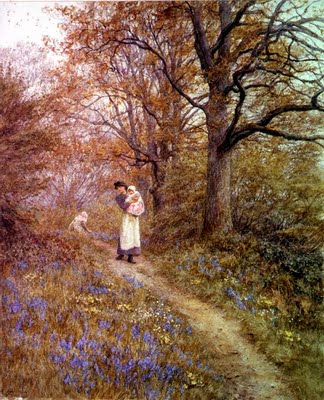
October


[Image: The Shepherd’s Calendar (October) – Carry Akroyd]

With wicker basket swinging on her arm
Searching the hedges of home close or farm
Where brashy eldern trees to autumn fade
Wild shines the hedge in autumns gay parade
The glossy berrys picturesquely weaves
Their swathy bunches mid the yellow leaves
Where the pert sparrow stains his little bill
And tutling robin picks his meals at will
Black ripening to the wan suns misty ray
Here the industrious hus wives wend their way
Pulling the brittle branches carefull down
And hawking loads of berrys to the town
While village dames as they get ripe and fine
Repair to pluck them for their ‘eldern wine’
That bottld up becomes a rousing charm
To kindle winters icy bosom warm
That wi its merry partner nut brown beer
Makes up the peasants christmass keeping cheer

(lines 71-88)

John Clare – The Shepherd’s Calendar (October)

There has been a fermentation too in the mind of John Clare, a fever almost, a frenzy of scribbling. Since first he learned his ABCs he has scratched with his nib at whatever scrap of paper he could lay his hands upon. Most have been scrunched in his fist and thrown into the fire. Some he has folded most careful into the pages of his few precious books. But since Bridge Fair he has writ as one possessed. Whether it was that tattered volume that woke in him something that had long been slumbering. Or whether it is to sharpen and sweeten his tongue for Mary…

Each morning, along with the bread and cheese in his dinner bag, he must carry his paper and pencil stub. When the other men rest from their fencing or hedge-setting or stone-breaking and settle down for their baggin he sits apart and sets down the rhymes he has whispered to himself as he laboured. There are those that mock, and those that shrug, and those that say ‘Good luck to ye', but John is indifferent to them all. He is in a maze of words that will not let him be, they come spilling and rhyming from his tongue and he delights in the pictures they summon. And then, when a poem is done, he will doubt it also.

Hugh Lupton – The Ballad of John Clare (Chapter 10 – All Hallows’ Eve)

Sun-rising in September

How delightfuly pleasant when the cool chilling air
By september is thrown oer the globe
When each morning both hedges and bushes do wear
Instead of their green—a grey robe.
To see the sun rise thro the skirts of the wood
In his mantle so lovley and red
It cheers up my spirits and does me much good
As thro the cold stubbles I tred.
Tho not that his beams more advances the scene
Or adds to the Landscape a charm
But all that delights me by him may be seen
That the ensuing hours will be warm.
And this with the poet as yet in the world
In a parrarel sence will comply
For when he does view the gay scenes there unfurl'd
Tis only to light him on high.

Song - O aince I loved the lily


O aince I loved the lily
As the first & fairest flower
& aince I luved the rose
On simmers hedge row bower
& I luv'd the white thorn bower
Clad softly green at spring
But sweeter then the flower
Is my luv' Mary King

I luved her in her childhood
In sorrow & in joy
Red as blossoms i' the wildwood
& brown as any boy
As the linnet luv's its young
I' the green leaves o' the spring
So I've often said & sung
Of my true luv' Mary King

Sae I've often said & sung
When her links o' flaxen hair
Oer her fair shoulders hung
& her little breast was bare
I luved her more & more
Till she got a fair young thing
Fond & tender as before
Was the bonny Mary King

& now she's ripe & blooming
I' the prime o' rosey may
& her bosoms luv' untombing
Bursts lace & pins away
‘All sueing to be prest’
White as snow drops o' the spring
Love warms the lily breast
O sweet bonny Mary King
My bonny Mary King

Ripe & rosey Mary King
Sweetest flower o' a' the spring
Is my ain true luv' Mary King
Sae I luv' her night & day
A ripe & bonny thing
Till lifes sands waste away
Young handsome Mary King

from "The Harvest Morning"


Cocks wake the early morn wi' many a Crow
Loud ticking village clock has counted four
The labouring rustic hears his restless foe
& weary bones & pains complaining sore
Hobbles to fetch his horses from the moor
Some busy 'gin to team the loaded corn
Which night throng'd round the barns becrouded door
Such plentious scenes the farmers yards adorn
Such busy bustling toils now mark the harvest morn
The birdboy's pealing horn is loudly blow'd
The waggons jostle on wi' rattling sound
& hogs & geese now throng the dusty road
Grunting & gabbling in contension round
The barley ears that litter on the ground—
What printing traces mark the waggons way
What busy bustling wakens echo round
How drives the suns warm beams the mist away
How labour sweats & toils & dreads the sultry day

(lines 1 to 18)

September


[Image: The Shepherd’s Calendar (September) – Carry Akroyd]

Harvest awakes the morning still
And toils rude groups the valleys fill
Deserted is each cottage hearth
To all life save the crickets mirth
Each burring wheel their sabbath meets
Nor walks a gossip in the streets
The bench beneath its eldern bough
Lined oer with grass is empty now
Where black birds caged from out the sun
Would whistle while their mistress spun
All haunt the thronged fields still to share
The harvests lingering bounty there
As yet no meddling boys resort
About the streets in idle sport
The butterflye enjoys his hour
And flirts unchaced from flower to flower
And humming bees that morning calls
From out the low huts mortar walls
Which passing boy no more controuls
Flye undisturbed about their holes
And sparrows in glad chirpings meet
Unpelted in the quiet street

John Clare – The Shepherd’s Calendar (September - excerpt)

Today has been the last of the harvest. The day broke with but one small stand of wheat still waiting on Lolham Bridge Field. But though it should have been a day of ease and joy with the promise of largesse and horkey writ large in every heart, it was a sombre village that woke to the harvest horn.

Dick and Bob Turnill had been leading a loaded cart back to their yard from Lolham Bridge Field when the bank beside Green Dyke gave way and the piled load lurched out of true. The cart tipped its grain into the dyke and one of the horses fell with his full weight upon his collar. He was struggling so fierce that none could get close enough to cut him free. Soon he was strangled, his tongue lolling between his teeth. Many had rallied to rake the soaked straw from the dyke and lay it to dry again, but a broken cart, a dead gelding and half a wagon-load of corn are a higher toll than Bob Turnill can afford to pay, as all the parish knows. It is a harsh God that he prays to so avid.

And there is a third sorrow too in the fence-posts and quick-thorn seedlings that wait on the moment when the harvest largesse is finished and autumn comes riding across the fields in her russets and ochres, red as the leaves of the dock and brown as its steeples of seed.

John and Parker Clare walked silently out to the field this morning. The other men were muted too, avoiding John's eye. For although most believed that the gypsy had reaped his just deserts, the transportation of a known man puts a quiet on the busiest tongue. There was not the usual babble of talk among the women either, rather a whispered, subdued gossiping. The children, though, ran and whooped as oblivious to care as the barking village dogs.

When they reached the stand of wheat the old rhythms of harvest that have governed these months of high summer were a balm to John's heart, for they demanded no more than the song of whet-stone to blade and the mindless drudgery of hard labour. Yesterday's sharp sorrow was numbed by an aching shoulder and a sweating back. Slowly and steadily as the morning progressed the wheat diminished in front of him and the stooks gathered behind.

It was mid-morning, when the wheat was all but taken, that a hare leapt out from between the stalks and dodged between the legs of the men. It was one of this year's leverets, full grown but gangly still, sleek and brown…

Hugh Lupton – The Ballad of John Clare (Chapter 8 – Harvest)

The Last of Summer (I)

A beauty on the scene attends
Ere autumn comes and summer ends,
When summer's glory first we see
As stained with its mortality.

Each morn wakes wan, its sunlight wanes
On yellowing leaves and fading plains;
Green fields no more the summer views,
All sickened into ripened hues

Of brown and grey and darksome glooms
That mark the path where autumn comes;
And in each woodland's buried way
The dewdrop lives for half the day.

Dank mists oft creep 'twixt earth and sky,
And dreaming dim the morning's eye,
And dullness wears along the while
As if the sun was loath to smile.

Yet at midday his feebled powers
Will brighten up in sultry hours,
And sweating toil, that often stops
To wipe aside the falling drops.

Pierced with his downward daily ray,
Wishes the lagging hours away.
By swallows we may plain perceive
When summer's on the point to leave.

(to be continued...)

The Nightingale

This is the month the nightingale, clod brown,
Is heard among the woodland shady boughs:
This is the time when in the vale, grass-grown,
The maiden hears at eve her lover's vows,
What time the blue mist round the patient cows
Dim rises from the grass and half conceals
Their dappled hides. I hear the nightingale,
That from the little blackthorn spinney steals
To the old hazel hedge that skirts the vale,
And still unseen sings sweet. The ploughman feels
The thrilling music as he goes along,
And imitates and listens; while the fields
Lose all their paths in dusk to lead him wrong,
Still sings the nightingale her soft melodious song.

from "Holywell"


From covert hedge, on either side,
The blackbirds flutter'd terrified,
Mistaking me for pilfering boy
That doth too oft their nests destroy;
And ‘prink, prink, prink,’ they took to wing,
In snugger shades to build and sing.
From tufted grass or bush, the hare
Oft sprung from her endanger'd lair;
Surprise was startled on her rout,
So near one's feet she bolted out.
The sun each tree-top mounted o'er,
And got church-steeple height or more:
And as I soodled on and on,
The ground was warm to look upon,
It e'en invited one to rest,
And have a nap upon its breast:
But thought upon my journey's end,
Where doubtful fancies did depend,
Urg'd on my lazy feet to roam,
Like truant school-boy kept from home

(lines 53 - 72)

The Nightingale's Nest

Ronnie Blythe on Desert Island Discs in 2001 -
 http://www.bbc.co.uk/radio4/features/desert-island-discs/castaway/aa729d2d#p00948y7

(One of his choices being Ted Hughes reading "The Nightingale's Nest" at Westminster Abbey on 13th June 1989 - see posting below):

Up this green woodland-ride let's softly rove,
And list the nightingale — she dwells just here.
Hush ! let the wood-gate softly clap, for fear
The noise might drive her from her home of love;
For here I've heard her many a merry year—
At morn, at eve, nay, all the live-long day,
As though she lived on song. This very spot,
Just where that old-man's-beard all wildly trails
Rude arbours o'er the road, and stops the way —
And where that child its blue-bell flowers hath got,
Laughing and creeping through the mossy rails—
There have I hunted like a very boy,
Creeping on hands and knees through matted thorn
To find her nest, and see her feed her young.
And vainly did I many hours employ:
All seemed as hidden as a thought unborn.
And where those crimping fern-leaves ramp among
The hazel's under boughs, I've nestled down,
And watched her while she sung ; and her renown
Hath made me marvel that so famed a bird
Should have no better dress than russet brown.
Her wings would tremble in her ecstasy,
And feathers stand on end, as 'twere with joy,
And mouth wide open to release her heart
Of its out-sobbing songs. The happiest part
Of summer's fame she shared, for so to me
Did happy fancies shapen her employ;
But if I touched a bush, or scarcely stirred,
All in a moment stopt. I watched in vain:
The timid bird had left the hazel bush,
And at a distance hid to sing again.
Lost in a wilderness of listening leaves,
Rich Ecstasy would pour its luscious strain,
Till envy spurred the emulating thrush
To start less wild and scarce inferior songs;
For while of half the year Care him bereaves,
To damp the ardour of his speckled breast;
The nightingale to summer's life belongs,
And naked trees, and winter's nipping wrongs,
Are strangers to her music and her rest.
Her joys are evergreen, her world is wide—
Hark ! there she is as usual— let's be hush—
For in this black-thorn clump, if rightly guest,
Her curious house is hidden. Part aside
These hazel branches in a gentle way,
And stoop right cautious 'neath the rustling boughs,
For we will have another search to day,
And hunt this fern-strewn thorn-clump round and round;
And where this reeded wood-grass idly bows,
We'll wade right through, it is a likely nook:
In such like spots, and often on the ground,
They'll build, where rude boys never think to look—
Aye, as I live! her secret nest is here,
Upon this white-thorn stump! I've searched about
For hours in vain. There! put that bramble by—
Nay, trample on its branches and get near.
How subtle is the bird! she started out,
And raised a plaintive note of danger nigh,
Ere we were past the brambles; and now, near
Her nest, she sudden stops — as choking fear,
That might betray her home. So even now
We'll leave it as we found it: safety's guard
Of pathless solitudes shall keep it still.
See there! she's sitting on the old oak bough,
Mute in her fears; our presence doth retard
Her joys, and doubt turns every rapture chill.
Sing on, sweet bird! may no worse hap befall
Thy visions, than the fear that now deceives.
We will not plunder music of its dower,
Nor turn this spot of happiness to thrall;
For melody seems hid in every flower,
That blossoms near thy home. These harebells all
Seem bowing with the beautiful in song;
And gaping cuckoo-flower, with spotted leaves,
Seems blushing of the singing it has heard.
How curious is the nest; no other bird
Uses such loose materials, or weaves
Its dwelling in such spots: dead oaken leaves
Are placed without, and velvet moss within,
And little scraps of grass, and, scant and spare,
What scarcely seem materials, down and hair;
For from men's haunts she nothing seems to win.
Yet Nature is the builder, and contrives
Homes for her children's comfort, even here;
Where Solitude's disciples spend their lives
Unseen, save when a wanderer passes near
That loves such pleasant places. Deep adown,
The nest is made a hermit's mossy cell.
Snug lie her curious eggs in number five,
Of deadened green, or rather olive brown;
And the old prickly thorn-bush guards them well.
So here we'll leave them, still unknown to wrong,
As the old woodland's legacy of song.

Song


One gloomy eve I roamed about
  Neath Oxey's hazel bowers,
While timid hares were darting out,
  To crop the dewy flowers;
And soothing was the scene to me,
  Right pleased was my soul,
My breast was calm as summer's sea
  When waves forget to roll.

But short was even's placid smile,
  My startled soul to charm,
When Nelly lightly skipt the stile,
  With milk-pail on her arm:
One careless look on me she flung,
  As bright as parting day;
And like a hawk from covert sprung,
  It pounced my peace away.

A World for Love

O this world is all too rude for thee with much ado & care
O this world is but a rude world & hurts a thing so fair
Was there a nook in which the world had never been to sere
That world would prove a paradise when thou & love was near
& there to pluck the blackberry & there to reach the sloe
How joyously & quietly would love thy partner go
Then rest when weary on a bank where not a grassy blade
Had ere been bent by troubles feet & love thy pillow made
For summer would be evergreen though sloes was in their prime
& winter smile his frowns to spring in beautys happy clime
& months would come & months would go & all in sunny moods
& every thing inspired by thee grow beautifully good
& there to seek a cot unknown to any care & pain
& there to shut the door alone on singing wind & rain
Far far away from all the world more rude then rain or wind
& who could wish a sweeter home or better place to find
Then thus to live & love with thee thou beautiful delight
Then thus to love & live with thee the summer day & night
& earth itself where thou had rest would surely smile to see
Herself grow eden once again possest of love & thee

(from ‘Midsummer Cushion’)

Native Scenes


O Native Scenes, for ever dear!
So blest, so happy as I here have been.
So charm'd with nature in each varied scene,
To leave you all is cutting and severe.
Ye hawthorn bushes that from winds would screen,
Where oft I've shelter'd from a threaten'd shower ;
In youth's past bliss, in childhood's happy hour,
Ye woods I've wandered, seeking out the nest;
Ye meadows gay that rear'd rae many a flower,
Where, pulling cowslips, I've been doubly blest.
Humming gay fancies as I pluck'd the prize :
Oh, fate unkind! beloved scenes, adieu!
Your vanish'd pleasures crowd my swimming eyes,
And make the wounded heart to bleed anew.

Oh, Wert Thou in the Storm


Oh, wert thou in the storm,
How I would shield thee!
To keep thee dry and warm
A camp I would build thee.

Though the clouds poured again,
Not a drop should harm thee;
The music of wind and rain
Rather should charm thee.

Oh, wert thou in the storm,
A shed I would build for thee,
To keep thee dry and warm.
How I would shield thee!

The rain should not wet thee
Nor thunderclap harm thee;
By thy side I would set me
To comfort and warm thee.

I would sit by thy side, love,
While the dread storm was over,
And the wings of an angel
My charmer would cover.

Sonnet: "Rural Scenes"

I never saw a man in all my days—
One whom the calm of quietness pervades—
Who gave not woods and fields his hearty praise,
And felt a happiness in summer shades.
There I meet common thoughts, that all may read
Who love the quiet fields:—I note them well,
Because they give me joy as I proceed,
And joy renewed, when I their beauties tell
In simple verse, and unambitious songs,
That in some mossy cottage haply may
Be read, and win the praise of humble tongues
In the green shadows of some after-day.
For rural fame may likeliest rapture yield
To hearts, whose songs are gathered from the field.

When with our little ones we spent

When with our little ones we spent
Each Sunday after tea,
And up the wood's dark side we went
Or pasture's rushy lea,
To look among the woodland boughs
To find the bird's retreat,
Or crop the cowslip for the cows;
Then sat to rest the little feet
In many a pleasant place,
And see the lambs, who tried to bleat,
Come first in every race,
Then laugh'd the children's joys to view,
Who ran across the lea
At birds that from the rushes flew,
And many a wandering bee.

August


[Image: The Shepherd’s Calendar (August) – Carry Akroyd]

Of old and young their daily tasks pursue
The barleys beard is grey and wheat is brown
And wakens toil betimes to leave the town
The reapers leave their beds before the sun
And gleaners follow in the toils begun
To pick the littered ear the reaper leaves
And glean in open fields among the sheaves
The ruddy child nursed in the lap of care
In toils rude strife to do his little share
Beside his mother poddles oer the land
Sun burnt and stooping with a weary hand
Picking his tiney glean of corn or wheat
While crackling stubbles wound his little feet
Full glad he often is to sit awhile
Upon a smooth green baulk to ease his toil
And feign would spend an idle hour to play
With insects strangers to the moiling day
Creeping about each rush and grassy stem
And often wishes he was one of them
In weariness of heart that he might lye
Hid in the grass from the days burning eye
That raises tender blisters on his skin
Thro holes or openings that have lost a pin
Free from the crackling stubs to toil and glean
And smiles to think how happy he had been
Whilst his expecting mother stops to tye
Her handful up and waiting his supply

John Clare – The Shepherd’s Calendar (August - excerpt)

The rhythm and hard labour of these harvest days have been a sweet relief to John. They have rendered him too tired to think. All morning the team of men, in smocks and wide-brimmed hats of rush or straw, worked together. They swung their curved blades in the easy accord that their health depends upon, for to be out of rhythm is to cut flesh to bone of the man alongside. From time to time they stopped to sharpen their blades, drawing the whet-stones along the curved blades, two strokes below and one above. The scythes rang out like cutlasses. Then they'd return to their harvest, Richard Royce leading, the others falling in behind, like fiddlers in a band with their bows rising and falling in perfect time.

The women followed, Ann Clare and Betsy Jackson amongst them. They gathered the fallen swathes of wheat in their arms and lifted them up, as though tending the fallen. They tied each sheaf with twisted straw. They leaned the sheaves together, six at a time, into stocks. Behind them row upon row of lifted stooks stood, each like a cluster of tousle-headed prisoners of war bound together back to back. Overhead a fierce sun beat down upon bent backs.

On the other side of Lolham Bridge Field, where Mr Bull's and Bob Turnill's stooks had stood three weeks in bright sunshine, two great carts had been drawn to the edge of their furlongs. One man stood in each and built the load, six more forked the sheaves up to them as they worked. The waiting horses stamped in the heat.

Beyond them, where the stooks had all been taken, Kitty Otter, Sophie Clare and a gaggle of other girls, old women and village paupers were gleaning the stubble for spilt grain.

Hugh Lupton – The Ballad of John Clare (Chapter 7 – Harvest)

The Return: Northborough, 1841 (excerpt)

Now melancholy autumn comes anew
With showery clouds and fields of wheat tanned brown;
Along the meadow banks I peace pursue
And see the wild flowers gleaming up and down,
Like sun and light; the ragwort's golden crown
Mirrors like sunshine when sunbeams retire,
And silver yarrow: there's the little town,
And o'er the meadows gleams that slender spire,
Reminding me of one, and waking fond desire.
I love thee, nature, in my inmost heart;
Go where I will, thy truth seems from above;
Go where I will, thy landscape forms a part
Of heaven: e'en these fens, where wood nor grove
Are seen, their very nakedness I love,
For one dwells nigh that secret hopes prefer
Above the race of women; like the dove,
I mourn her absence; fate, that would deter
My hate for all things, strengthens love for her.

Written in a Thunderstorm, 15 July 1841

THE heavens are wroth; the thunder's rattling peal
Rolls like a vast volcano in the sky;
Yet nothing starts the apathy I feel,
Nor chills with fear eternal destiny.
My soul is apathy, a ruin vast;
Time cannot clear the ruined mass away;
My life is hell, the hopeless die is cast,
And manhood's prime is premature decay.
Roll on, ye wrath of thunders, peal on peal,
Till worlds are ruins, and myself alone;
Melt heart and soul, cased in obdurate steel,
Till I can feel that nature is my throne.
I live in love, sun of undying light,
And fathom my own heart for ways of good;
In its pure atmosphere, day without night
Smiles on the plains, the forest, and the flood.
Smile on, ye elements of earth and sky,
Or frown in thunders as ye frown on me;
Bid earth and its delusions pass away,
But leave the mind, as its creator, free.

[Image: George Morland]

John Clare Tweets (Click here)

"Tweets have become a contemporay Haiku, at their best artfully worded moments of linguistic economy, abbreviation, and beauty." (Simon Pegg)  Clare, in all his vast output, was ahead of his time in his ability to capture a scene or mood in just a few lines, just like a Tweet.  So here we are, my experiment in Clare Tweet postings... suggestions will be used!

Ronald Blythe on the Festival

You might like to read Ronnie's 'report' of the 30th Festival... 

"Back once more from the John Clare Festival at Helpston. Our Society has outgrown the school named after him, and has to fill a marquee. Rows and rows of familiar faces. The village has wide Enclosure roads and handsome Barnack-stone houses, toppling hollyhocks, and bird-filled skies. As always, I see the poet running over the fields to Glinton, to be taught to read and write for a penny a week, and to do his arithmetic in the dust of the threshing barn, and to lie hidden with a book in a deserted quarry.

What a good education he got, one that was perfect for our greatest rural voice. Clare, too, had a violin. The gypsies showed him how to play it. We had lunch in the Blue Bell, where he would be found with his beer and his finds — wild flowers. They would straggle from his velvet pockets. Have you read John Clare? If not, do so at once. His life was bitter-sweet with a vengeance. Poor Clare. Great Clare."

Hail, humble Helpstone ! where thy vallies spread,
And thy mean village lifts its lowly head ;
Unknown to grandeur, and unknown to fame;
No minstrel boasting to advance thy name :

Unletter'd spot! unheard in poets' song;
Where bustling labour drives the hours along ;
Where dawning genius never met the day;
Where useless ignorance slumbers life away.